Workplace ear care
On-site ear checks and wax removal for staff, run through the working day at your premises.
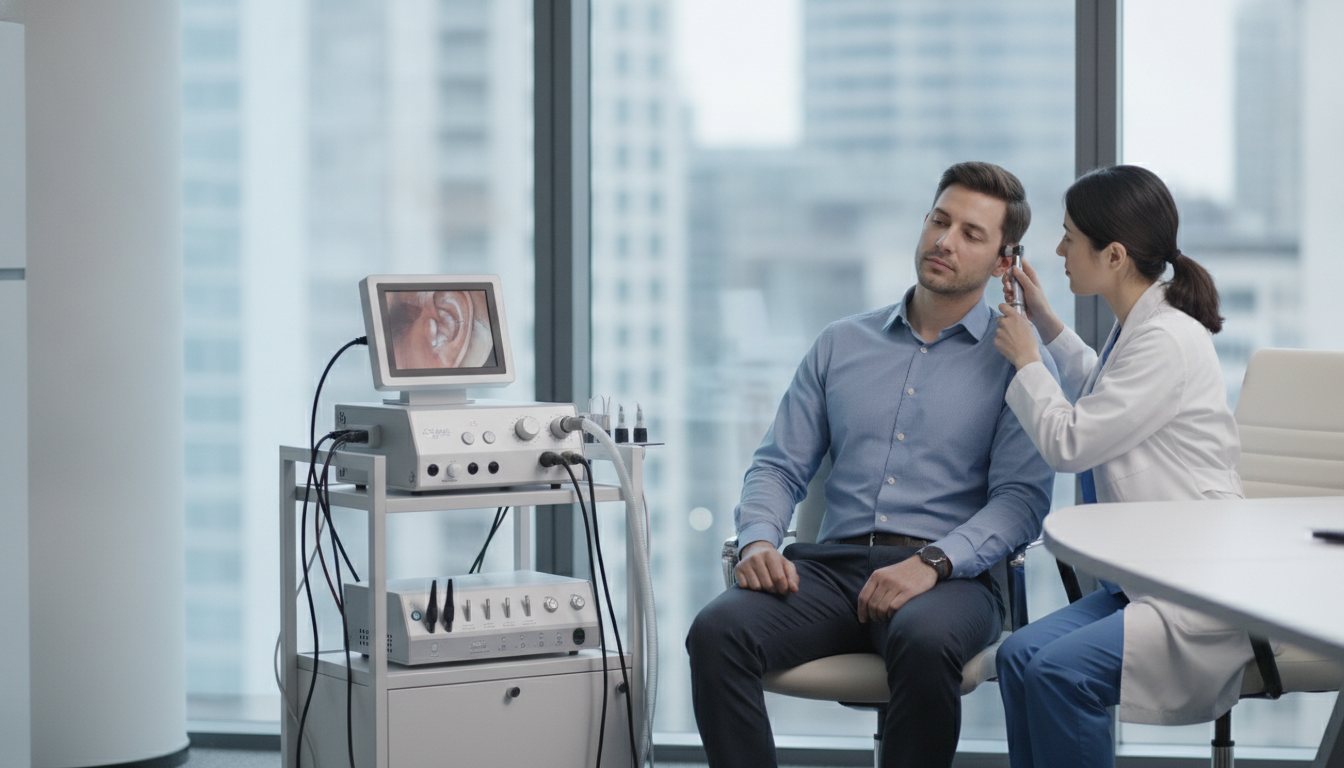
How a session works
A meeting room or quiet office is set aside and staff come through on a rolling timetable, usually fifteen to twenty minutes each. Most teams of eight to twelve are cleared within a single day.
Who benefits
Construction, manufacturing and motor trades where ear defenders are worn all day; drivers and plant operators; call centre and headset users; and anyone whose hearing protection or in-ear equipment has started to fit badly or whistle.
Booking and invoicing
Sessions can be invoiced to the company or paid individually by each member of staff. Call to discuss numbers, dates and a rate for your team.
Ear health in noisy trades
People who wear hearing protection all day have a double interest in clear ears. Earplugs and defenders slow the canal's natural wax migration, so wax builds faster, and a canal already narrowed by wax makes plugs fit worse, seal worse and irritate more. Blocked ears also stack with protector attenuation: an employee losing ten or fifteen decibels to wax, then another twenty-plus to their protection, can end up dangerously isolated from speech, alarms and vehicle noise. Clearing wax does not replace any part of a noise-at-work programme, but it removes an avoidable, invisible layer of hearing loss from people who need every decibel they can get.
Before hearing tests and protector fitting
If your workplace runs audiometry, whether as part of health surveillance or otherwise, blocked ears are a known nuisance: wax against the eardrum can drag down thresholds and trigger avoidable referrals and retests. A wax-clearance session shortly before a testing round means results reflect employees' actual hearing rather than their housekeeping. The same logic applies to custom-moulded earplugs and in-ear monitors, where impressions cannot be taken of an occluded canal, and to headset-heavy roles where a blocked ear turns a normal shift into a straining one. Scheduling clearance a week or two ahead of these events is the single most useful timing decision a booking contact can make.
Confidentiality and records
Each employee is seen individually and their clinical details stay between them and the clinician; being examined in a meeting room does not make findings a workplace matter. The employer booking the session receives practical information only, such as attendance and any general recommendation to repeat sessions, never individual clinical findings, unless an employee explicitly asks for something to be shared. Each person treated gets their own explanation of what was found, aftercare advice, and a recommendation to see their GP where anything beyond wax is spotted. Employees who decline on the day are simply marked as not seen, with no reason recorded or requested.
Setting up a session that runs smoothly
The practical requirements are one quiet room with a chair, a table and a socket, plus a simple timetable so staff are not queueing in a corridor. Fifteen to twenty minutes per person is realistic; managers who circulate olive-oil-drops advice a few days beforehand consistently get more ears cleared per session. Anyone found with clear ears still gets the examination and advice, which is itself useful before audiometry. Sessions can run to shift patterns, including early starts, and repeat visits every six or twelve months suit most noisy-trade teams. Numbers, dates and a team rate are agreed by phone before anything is booked.
Good to know
- On-site at your premises
- Around fifteen minutes per person
- Company invoice or individual payment
- Useful before hearing protection fitting