Children's ear wax removal
Children are treated from age five, at their pace, with a parent or guardian present throughout the appointment.
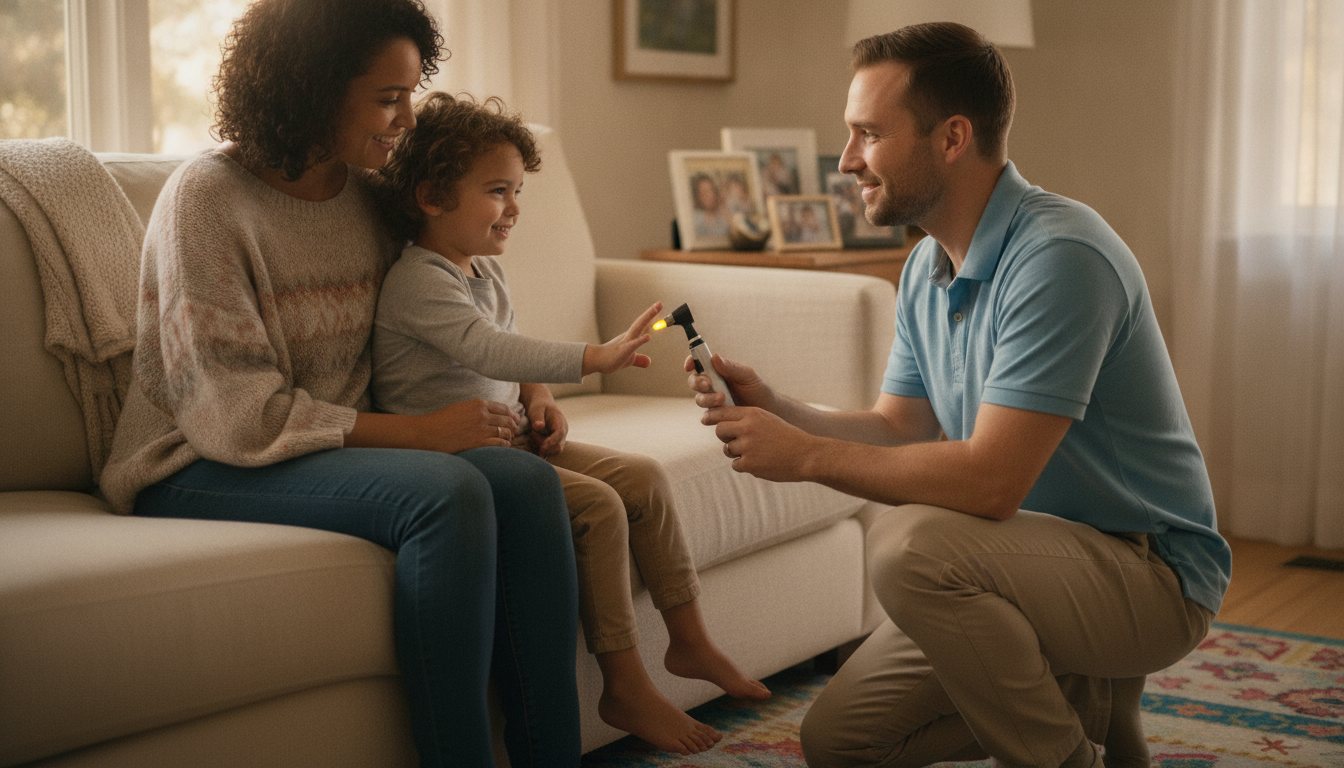
How the appointment runs
Nothing goes near an ear until your child has seen the equipment, heard what it sounds like and agreed to go ahead. Appointments are booked with extra time so there is no pressure to hurry, and treatment stops immediately if your child asks it to.
Additional needs
Children who are autistic, anxious or sensitive to noise are very welcome. Tell us when booking and the appointment is adapted — a quieter approach, longer settling time, or a first visit that is examination only with treatment at a second visit.
Parents stay throughout
A parent or guardian must be present for the whole appointment and can sit with their child or hold them on their lap. Being at home rather than in a clinic room makes a considerable difference to most children.
Signs a child may have a wax problem
Children rarely announce that an ear is blocked. More often the clues are indirect: the television creeping louder, "pardon?" becoming a habit, a teacher mentioning inattention, a child tugging or poking at one ear, or speech that suddenly seems less clear. Some children complain of a blocked or "underwater" feeling after swimming or a cold. Because these signs overlap with glue ear and other middle-ear problems common in childhood, an examination is genuinely useful either way: it either finds wax that can be removed on the spot, or finds clear canals and gives you solid grounds to ask your GP about what sits behind the eardrum instead.
How children's ears differ
A child's ear canal is narrower, shorter and more sensitive than an adult's, and the eardrum sits closer to the entrance, so margins are smaller and patience matters more than speed. Children also produce softer wax that often clears itself, which is one reason treatment is not automatic; a canal that is half-full but functioning is frequently better left alone with advice than instrumented. Where removal is needed, the method is chosen for the child in front of us, gently and with frequent pauses. The threshold for stopping is deliberately low: a distressed child is never held still for treatment, and a second, shorter visit usually succeeds where a forced first one would fail.
What parents can do beforehand
Talk about the visit in plain terms: someone is coming to look in your ears with a little torch, and it does not hurt. Avoid promising "they won't touch you", since a gentle examination involves touch, and broken promises make second visits harder. A few days of olive oil drops beforehand, if your child tolerates them, softens wax and shortens treatment; do not force drops on an unwilling child. Skip cotton buds entirely. Plan the visit for a time of day when your child is fed and rested, and have a favourite toy, tablet or programme on hand, because a comfortably distracted child on their own sofa is the easiest patient there is.
When a child will not be treated
Honesty matters more with children than anyone. Children under five are not treated, because canal size and cooperation make home removal inappropriate at that age; concerns about a younger child's ears belong with your GP. Treatment also stops or is not started where there are signs of infection, a suspected perforation, a foreign object sitting deep in the canal, or where a child, once everything has been explained at their level, does not agree to go ahead. In each of those cases you will be told exactly what was seen and what to do next, and an examination-only visit that ends in a GP referral is treated as a proper outcome, not a failure.
Good to know
- From age five upwards
- Extra appointment time built in
- Parent or guardian present throughout
- Treatment stops the moment your child asks