Care home visits
Regular or one-off visits to residential and nursing homes across mid-Kent, working alongside your care staff.
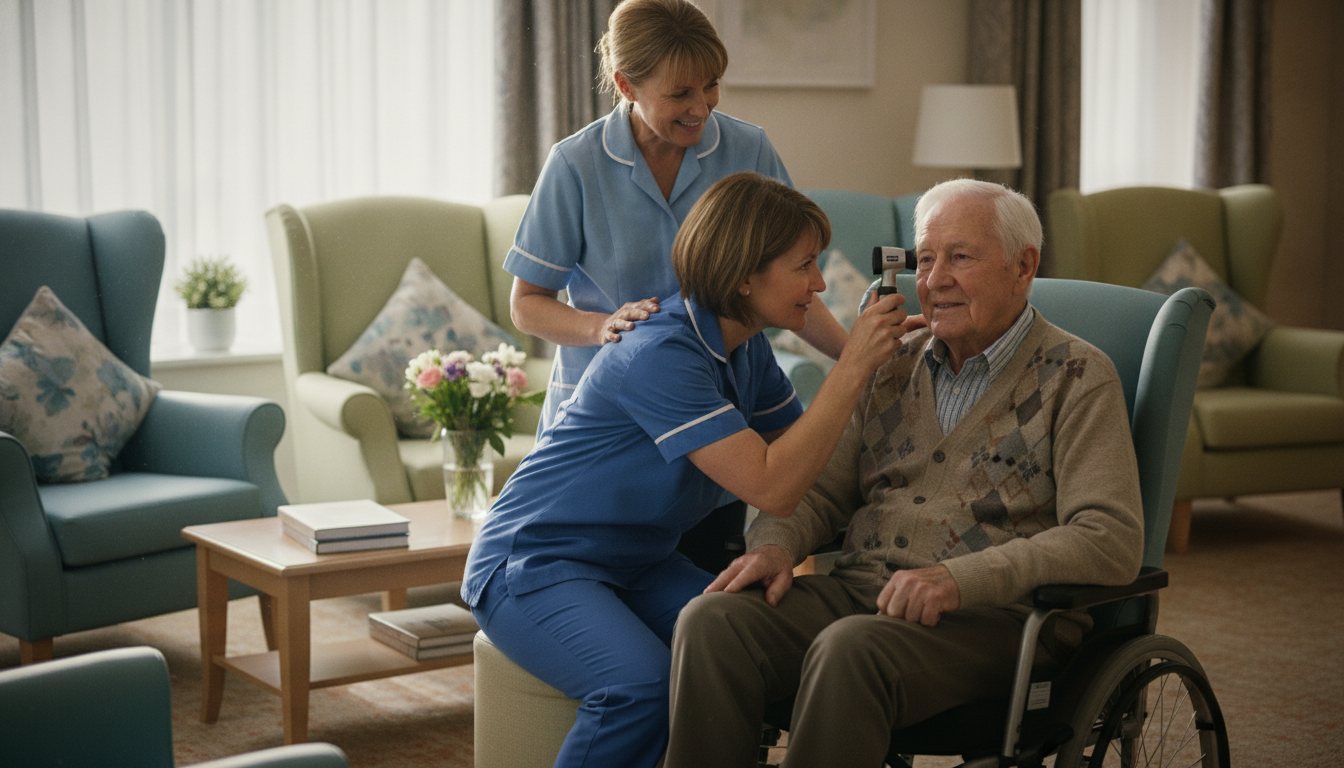
How visits are arranged
Your home manager gives a list of residents and a preferred date. Residents are seen in their own room or a quiet communal space, in whatever order suits the daily routine. Consent and capacity are checked with your team before each resident is treated.
Why it matters for residents
Untreated wax is a frequent and easily missed cause of apparent confusion, withdrawal and hearing-aid failure in older people. Clearing it often produces an immediate and visible improvement in how well a resident engages with those around them.
Records and rates
Written notes are provided for each resident's care file, including anything that warrants a GP review. Per-resident rates apply from three residents upward — call for a quote for your home.
Consent, capacity and dignity
Wax removal in a care setting is only done properly when consent is handled properly. Residents who can consent for themselves are asked directly, in terms they can follow, and their answer is final. Where capacity is in doubt, the visit follows the home's own procedures and the principles of the Mental Capacity Act: decisions are made in the resident's best interests, in consultation with your staff and, where appropriate, family, and are recorded. A resident who becomes distressed is never treated for the sake of completing a list. Care staff know their residents far better than a visiting clinician can, and their read of a resident's mood on the day is always respected.
Preparing residents before a round
The most productive care home rounds are the ones prepared a few days in advance. Where the home's own procedures allow, a short course of olive oil drops for listed residents in the days before the visit softens hard wax and noticeably increases the proportion of ears cleared in a single session. It also helps to have hearing aids, their cases and any known ear history to hand, and to let residents know in advance, in whatever way suits each person, that someone is coming to look at their ears. None of this is essential, and residents are never excluded for being unprepared, but a small amount of groundwork saves repeat visits.
Hearing aids in care settings
Hearing aids and wax cause each other trouble in both directions: aids block the canal's natural clearing, and wax blocks, muffles and whistles through aids, which then get abandoned in drawers. During a round, each treated resident's aids can be checked for wax in the domes, guards and tubing at the same time, and staff shown what a clogged wax guard looks like so problems are caught between visits. For residents whose "broken" aid turns out to be a blocked ear, or vice versa, the notes for the care file say so explicitly, giving your team something concrete to pass to the resident's audiologist or GP.
Fitting around your home, not the other way round
Rounds are scheduled to fit the rhythm of your home: after breakfast and personal care, around activities, and never during mealtimes unless your team prefers it. Each resident is seen where they are most comfortable, and the equipment moves to them. Sign-in, ID and DBS documentation are presented as your policy requires, and infection control follows your home's standards alongside standard clinical practice, with single-use consumables throughout. Visits can be one-off, for a specific resident causing concern, or a recurring round every few months that keeps the whole home's ears, and hearing aids, working. Staff are always welcome to sit in.
Good to know
- Enhanced DBS checked and fully insured
- Residents seen in their own room
- Written notes for each care file
- Group rates from three residents